
Greenvines | Healing Chamber of Jazz: Opening a Window from Underground
Before people could smell the fragrance, they first learned how to breathe.
Greenvines’s auscentic creates fragrance from naturally derived pure essential oils.
It chooses to keep scent within 1.5 metres: close enough to be noticed by someone nearby, and gentle enough to respect a real formula, a breathing body, and the space shared with others.
This quality can be difficult to describe through the usual language of fragrance. When “natural,” “non-toxic,” and “safer” become the main story, a brand can easily be placed inside a functional comparison, sometimes one shaped by anxiety.
More importantly, auscentic users are not one audience. They are individuals moving through different hours, emotions, and rhythms of life.
The project began with a quieter, more fundamental question:
Everyone deserves to breathe for real.
Why This Case Matters
X — Reframing the Relationship
Let what is above ground and what is below it support one another.
Healing Chamber of Jazz: Opening a Window from Underground took place in the Performing Arts Library at the National Theater and Concert Hall.
Founded in 1993, the library sits beneath the National Theater, in a public space that many visitors pass without knowing what it holds. Its collection exceeds 190,000 items, including posters, programmes, and audiovisual records from productions presented by the National Theater and Concert Hall. Around 110,000 are audiovisual materials. The Special Collection Room preserves more than 20,000 vinyl records, over 40,000 CDs, and vintage record players.
NTCH Summer Jazz is part of Taipei’s cultural rhythm each summer. International and Taiwanese musicians, concerts, workshops, free outdoor gatherings, craft beer, and people staying late in the plaza all make jazz feel larger than a ticketed performance.
Greenvines’ own fragrance brand, auscentic, brought another kind of daily practice.
It cares about plants, ingredients, everyday use, and the choices people make when they want to cause less harm through what they consume.
The relationship between NTCH and Greenvines was like a tree.
The branches above ground offer shade and care. The roots underneath take in nourishment and keep the tree steady. Together, they form a living force.
Through everyday objects, NTCH found another path for public culture to enter daily life. Through NTCH’s cultural texture, Greenvines entered a conversation that could be heard with seriousness.
Here, a national cultural institution and a consumer brand did not stand at opposite ends of a hierarchy. They became responsive to one another.
Y — Building a Shared Stage
Let jazz, scent, and five states of mind bring people into the library.
Healing Chamber of Jazz began with a small idea: everyone can find their own soil for jazz.
Jazz offered sound and rhythm. The underground library held time and memory. Fragrance offered a clue close to the body. Together, they formed a kind of soil where visitors could begin from their own emotional state and grow a way of listening that belonged to them.
An interactive prompt, Discover Your Jazz Resonance, invited visitors to notice how they felt in that moment. From there, they moved toward one of five paths: joy, romance, awakening, rebellion, or solitude.
Five jazz states of mind, five auscentic natural micro-fragrances, and classic jazz works from the collection met inside the library.
MÖTHEA translated sustainability into a cultural setting.
It translated culture into a sensory atmosphere.
Then it allowed the atmosphere to become something people could enter, carry away, and remember.
Across five rooms, sound, instruments, plants, light, soil, and spatial storytelling came together. Each room offered a different way into the library.
-
Sunlit Beginning carried the feeling of breath arriving from the front.
The violin was chosen because it is a body that breathes. Its wood absorbs and releases moisture as temperature and humidity change. It expands and contracts in tiny movements, much like a human chest rising and falling.
Visitors bent down and looked through the endpin hole at the bottom of the violin. Inside, they saw the hollow body of the instrument and the curve of light moving across it.
Some called it a violin with abs. Others called it a violin with a chest.
For a moment, it seemed to open itself to the air.
-
Shan Shan: Here I Calm was placed in the library’s meeting room.
An ordinary conference table sat beside an eye-test lightbox. Different levels of sight were paired with the visual abilities of gorillas, eagles, owls, and other living beings.
The symbols came from the Tumbling E Chart, familiar to many people in Taiwan from childhood medical visits. Before they know the letter E, many children call its changing directions “mountains.”
Shan Shan is a fragrance with a visual landscape. Bergamot, pine needle, and petitgrain bring to mind a clear stream near the mountain, then mist moving across a distant range.
A scent can bring someone back to a very small and very real moment.
-
Inner Dawn drew from the rebellious spirit of Charles Mingus and his refusal to stay inside the old rules of jazz.
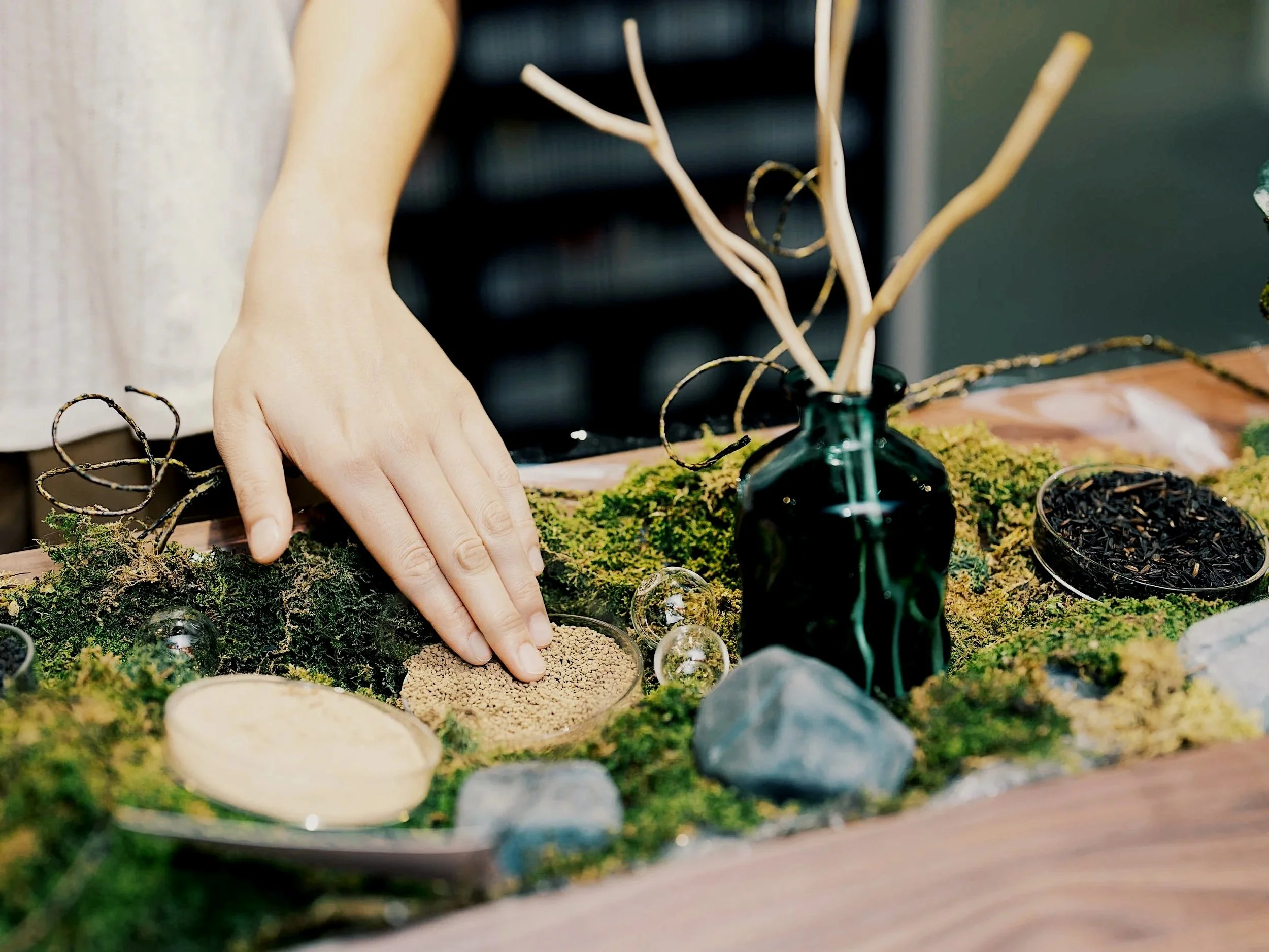
Together with succulent specialists, the exhibition created a green space that could be touched and could live quietly underground for a long time. Visitors could touch the soil. Even a cactus could feel unexpectedly gentle.
The space returned people to a simple truth: nature has never followed the uniform standards of industrial production.
A packet of stomach medicine was hidden in the exhibition. It pointed to a closer relationship with soil than most people realise. Some common anti-diarrhoeal medicines use minerals such as montmorillonite, a natural clay.
In Chinese-speaking life, “I’ll be eating soil this month” is also a familiar expression for having no money left. It may come after Lunar New Year red envelopes, after a partner’s birthday, or after paying a child’s tutoring fees.
The phrase is a little bitter, but very human.
Soil seems far below our feet. Yet it enters medicine, the body, language, and memory. It stays with us.



Z — A Way of Smelling Shaped by Visual Disability
Light, time, and emotion return fragrance to a human life.
MÖTHEA’s founder lives with visual disability.
At a press event, she shared a memory from childhood:
When my mother took me to the market, she would pick up an apple and ask, “Does it smell good? Try it. Is it sweet?”
I said, “It smells good. It is sweet.”
She said, “That is the smell of sunlight.”
This memory became a way of smelling.
Greenvines invited MÖTHEA to move auscentic away from the conventional top-note, middle-note, and base-note structure. Instead, fragrance could be understood through states of life that people could recognise in themselves.
Each person could move at their own pace, and notice what kind of air, light, feeling, or sound they needed at that moment.
-
Youth, ripeness, flowers, fruit, and the feeling of sun inside a scent
-
The inner clock of coolness, warmth, and wood
-
The way a scent can wake a memory, invite pleasure, offer quiet, or bring someone closer to themselves
Fragrance became more than a product attribute to evaluate.
It allowed people to meet their own life experience again.
Through something real, people found a new way of breathing.
Before people could smell the fragrance, they first learned how to breathe.

Outcome
Bringing people underground, and bringing a brand into a deeper relationship.
More than 100,000 visitors entered NTCH’s underground Performing Arts Library during the festival
During Summer Jazz, the library became a public cultural destination for staying, listening, touching, and sensing
Five jazz states of mind, five natural micro-fragrances, and classic jazz holdings invited visitors to enter performing-arts archives through their own emotions
Open Window, Shan Shan, and Inner Dawn made violin craft, vision, plants, and soil into different ways of understanding fragrance
With NTCH’s licensing support, jazz music extended into Greenvines retail channels, allowing the exhibition’s sensory language to continue after the event